Is it dangerous to be compassionate?
Is it dangerous to be compassionate? It can certainly be. The ruthless killing of Alex Pretti who was trying to protect a fellow human being is a glaring example of the potential fatal consequences of being compassionate.
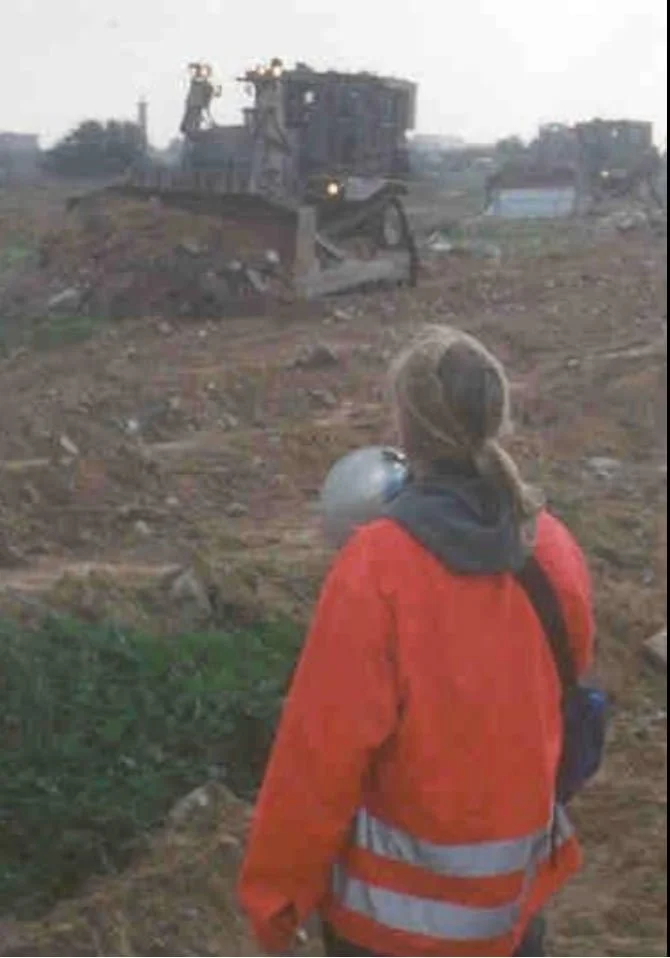
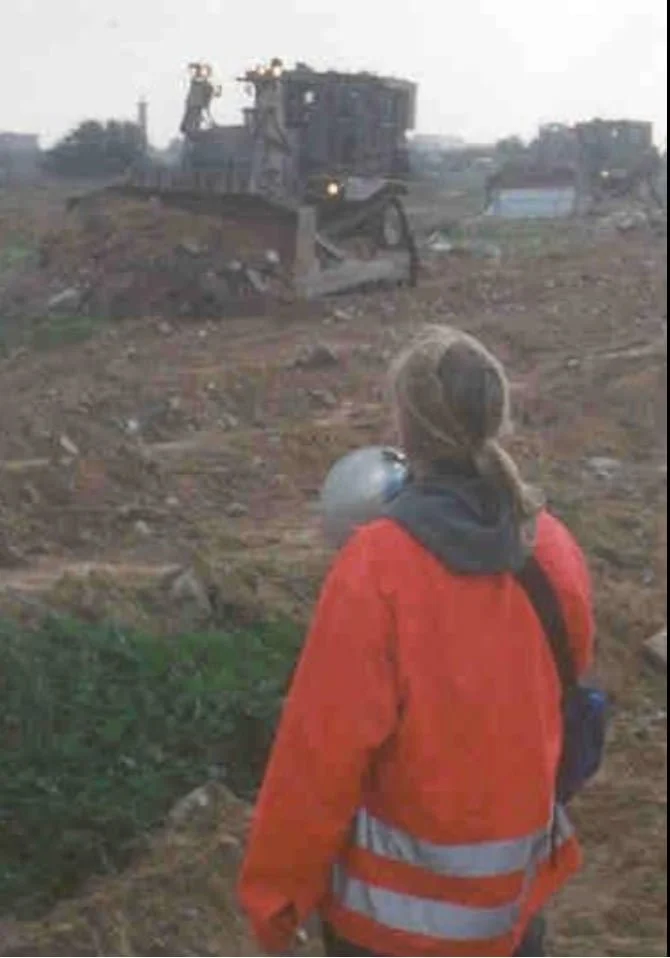
Rachel Corrie, aged 23, standing in front of an Israeli bulldozer in her attempt to stop the demolition of Palestinian homes. She was killed.
Perhaps the most outstanding historical example in answering this question is of a man considered the epitome of love and compassion – Jesus. He was crucified for challenging authority which was unjust and corrupt.
In the more recent history of our world, a man who has come to symbolize love, non-violence and compassion, MK Gandhi, was brutally murdered. In 1948, on this day, January 30th, he was murdered by Nathuram Godse, who acted on a philosophy of intolerance, supremacy and hate.
I write to you today, on Gandhi’s death anniversary, to discuss the question of whether compassion is dangerous. This question must be asked, especially in times of intense repression.
Compassion is a fundamental value of peace building in society. Without empathy – to feel for the pain and suffering of others – there can be no hope for co-existence.
It might surprise some that at the core of empathy is not an often cited abstract idea of “we are all human”. We can be raised or taught to feel no empathy – sometimes it is no empathy for specific groups of people and sometimes, shockingly, it can be a case of being raised with no empathy in general . Even if our human instincts tell us to care about the pain of other human beings, “othering” can dull or even block those instincts.
In simple words, it separates us from the one we consider the other and in its advanced stages can dehumanize that other in our eyes. We stop seeing or respecting what they feel. It can can go dangerously beyond that. We can actually start harming the other and not even feel bad about it. In fact, it makes us feel good because othering is often equated to enmity. In our minds, we think of it as protecting ourselves from our enemies because if we don’t get rid of them, they will get rid of us.
Sounds familiar? It is the exact logic that has been used to justify horrendous crimes like the Armenian genocide in Turkey, the Holocaust and the massacre of Palestinians by Israel.
But then there are so many examples of people who do feel the pain of others even when we do not see any connection between them. To go back to Alex Pretti and also to remind ourselves of Renee Nicole Good, they were both standing up for people who were quite different from them and in our current ruling narrative, their “enemies” – the other.
Both Good and Pretti were born in the US and were of European dissent and from a common understanding of identity, there was no reason for them to stand up to the authority that was claiming to protect them from the very “aliens” they wanted to defend.
What is it that drove them to do it? It was something that has always driven people to recognize the injustice meted out to others, the pain they are undergoing because of it and do something about it. It is what drives people to go even against their class interest or the perceived interest of their “identity group”.
The Europeans who stood up against slavery, the white men and women who stood up against apartheid in southern Africa, the Jews who have protested on the streets against Israel which is supposedly defending their identity, the non-Muslim and non-Christian Indians who are fighting the anti-minority policies of their government and every single person who has ever done something to defend the life and rights of another who was not part of their “tribe” or was even seen as their tribe’s enemy is driven by this force.
What is this force? It is what I will call survival instinct. It might sound strange but it is exactly that. A human being who recognizes that there are a set of values that must be protected and promoted for humanity to survive is a part and parcel of this force.
Without sounding mystical, what drives us to have compassion for others and act on it, is much bigger than any identity of race, ethnicity, religion, nation, class, etc., that we have created. It is the innate wisdom, learned through all the generations that have ever existed, that to survive as a species, we must have respect for life – our own and of others and even of the many living beings that form our eco system and the water and air and soil that nurture all of us.
As a peace educator, I have often attempted to explain the importance of each one of us as natural peace makers. Today, on January 30th, in remembrance of a man who spent his entire life building peace and was killed by a man whose ideology offered nothing to humanity except hate, I request you to consider two things:
1. Compassion may be dangerous but the alternative is much more dangerous. The absence of compassion is what causes most deaths and destruction. It is the absence of compassion – for other humans and our planet – that drives the behaviour of the greedy and arrogant.
2. While all of us have limitations on what we can do, what we must never do is to let our innate wisdom of compassion die. It has to be kept alive in all of us. Do what you can. Never tell yourself that your actions do not count. They do even if they look small.
In solidarity for a more peaceful world,
Shirin
Co-director, Peace Vigil
Peace Needs All of Us!
